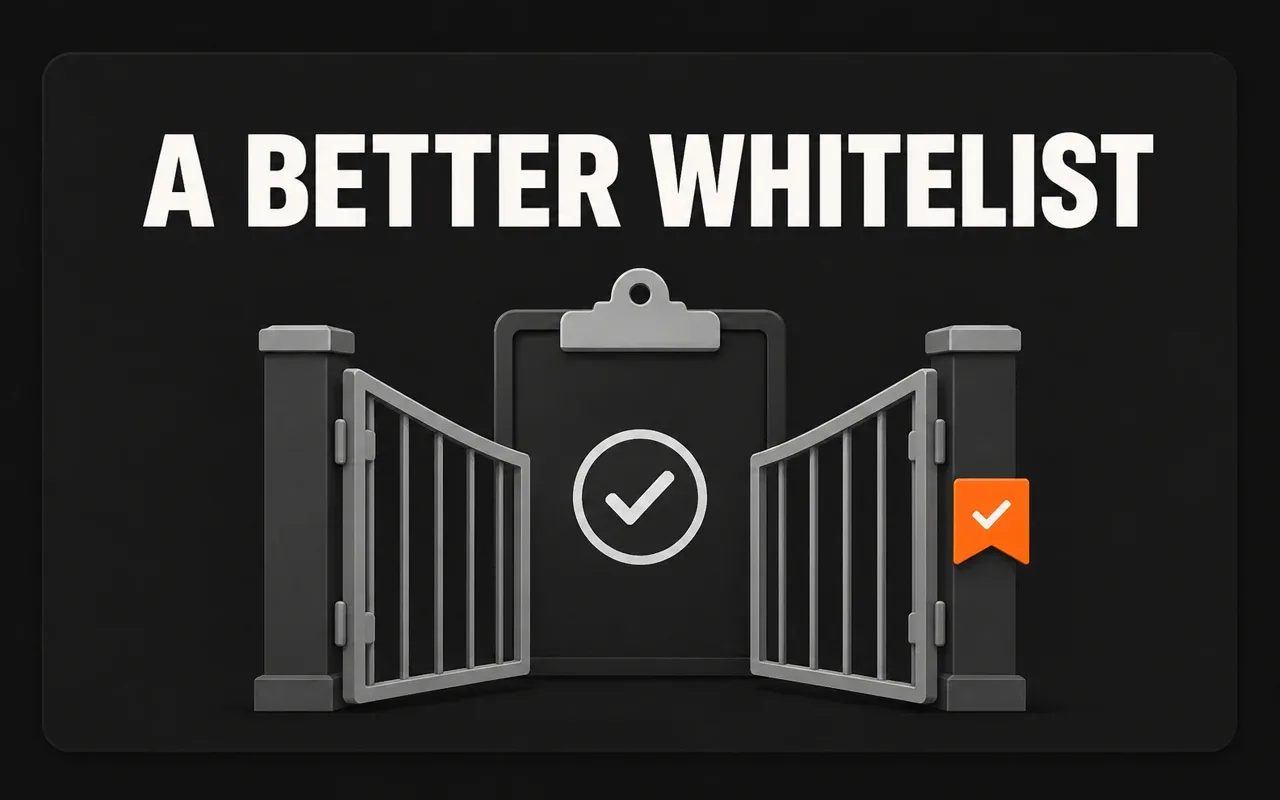
Every FiveM whitelist system is a trade-off between two things you both want: keeping out the trolls and letting in the good players. Push the gate too hard and you filter out exactly the patient, invested roleplayers you were trying to attract — because they’re also the ones with other servers to play on. Push it too soft and you spend your nights moderating griefers. The skill isn’t in building the wall; it’s in tuning how much friction it adds.
The Spectrum of Whitelisting
“Whitelist” covers a wide range of setups, and the right one depends entirely on your server’s size and goals:
- Open — anyone can join. Maximum reach, minimum quality control. Fine for a casual or new server building a population.
- App-based — players submit a written application, staff review, approval grants access. The most common serious-RP setup.
- Interview — a short voice or text interview on top of (or instead of) an application. High filter, high cost per applicant.
- Character-app — players are whitelisted per character, submitting a backstory for each one. Used by deep-RP servers that care about character quality, not just player behavior.
You don’t have to pick one forever. Plenty of servers run open access with a soft whitelist for general play and a hard whitelist gating specific privileged content — gangs, whitelisted jobs like police and EMS, or restricted areas.
Soft vs Hard Whitelist
This distinction is worth designing around deliberately. A soft whitelist lets players in to experience the server but limits what they can touch until they’ve cleared a bar — verified in Discord, completed a tutorial, or hit a playtime threshold. A hard whitelist blocks server access entirely until approved. Soft whitelisting lets a curious player feel the server before committing to an application, which dramatically improves conversion. Hard whitelisting protects high-stakes content and small communities that genuinely can’t absorb random traffic.
The pattern that works for most growing servers: soft entry to hook people, hard gates on the content where bad actors do the most damage.
Discord Verification and Bots
Almost every whitelist runs through Discord, and a verification bot is your first and cheapest filter. At minimum, a bot should:
- Tie a player’s Cfx/FiveM identifier to their Discord account, so a ban actually sticks across both.
- Require a basic verification step (react-to-verify, a captcha-style check) to filter out raid bots and throwaway accounts.
- Gate the application channel behind that verification, so only real members can even apply.
- Hand out the in-game whitelist role automatically once an application is approved, ideally syncing directly to your server’s ACE permissions or whitelist resource.
Account-age and server-membership requirements on the Discord side stop a huge fraction of throwaway-account trolls before a human ever reads anything.
Designing Application Questions That Actually Filter
The application is where most servers self-sabotage. A wall of twenty essay questions doesn’t filter for good players — it filters for people with free time, and it scares off good players who assume the server is full of itself. The goal is questions that are cheap for a genuine roleplayer to answer well and annoying for a troll to fake:
- Ask for understanding, not memorization. “Explain in your own words what fail-RP means to you” beats “What is rule 4.2 of our handbook?” The first surfaces whether someone actually gets roleplay; the second tests reading.
- Use a couple of scenario questions. “Your character is robbed at gunpoint — walk me through how you’d react in-character.” This is where trolls give themselves away instantly.
- Keep it short. Five to eight focused questions beats twenty. Every extra question costs you applicants and costs your reviewers time.
- Avoid copy-paste bait. A question whose answer can be googled or lifted from another server’s app filters nothing.
The Review Workflow and Reviewer Burnout
Behind every application queue is a tired volunteer. Reviewer burnout is the silent killer of whitelisted servers — applications pile up, wait times balloon, applicants give up, and population stalls. Protect your reviewers:
- Standardize scoring. A simple rubric (accept / soft-deny with feedback / hard-deny) keeps reviews fast and consistent and removes the emotional weight of each decision.
- Spread the load. Multiple reviewers with a claim system so two people don’t review the same app and nobody carries the whole queue.
- Template the responses. Pre-written accept/deny messages with a slot for personalized feedback save enormous time.
- Cap the queue if needed. Pausing new applications when the backlog is too deep is healthier than letting wait times silently stretch to two weeks.
The Conversion Cost of Friction
Every step between “I want to play here” and “I’m in the server” loses a percentage of applicants. Discord join, verify, read rules, write application, wait for review — each is a leak. That doesn’t mean removing friction; it means being deliberate about where you spend it. Friction on the application is friction well spent if it filters trolls. Friction from a confusing process or an unknown wait time is pure loss. The single biggest conversion win is usually just communicating the wait: “applications are reviewed within 48 hours” keeps people from quietly leaving.
Automating Approvals Where It’s Safe
Not everything needs a human. Auto-approving the trivial parts — Discord verification, role assignment on approval, playtime-based soft-whitelist unlocks — frees your reviewers to spend their judgment only where it matters: the written application. The goal is to reserve human attention for the one decision a bot can’t make well.
Where to Find Whitelist Resources and Further Reading
You don’t need to build the bot, the application form, and the in-game gate from scratch — these are well-solved problems. For Discord-integrated whitelist and verification systems plus the core roleplay resources behind them, Cfx.re whitelist and roleplay scripts is a solid starting point. For broader framework-agnostic whitelist and admin tooling, browse premium FiveM scripts, and for polished application UIs and onboarding resources, official FiveM store resources are worth a look before you commit to a stack.
The best whitelist is the one a good player barely notices and a troll never gets through. Tune the friction toward the application itself, automate everything around it, and communicate the wait — that’s what keeps your queue full of the players you actually want.