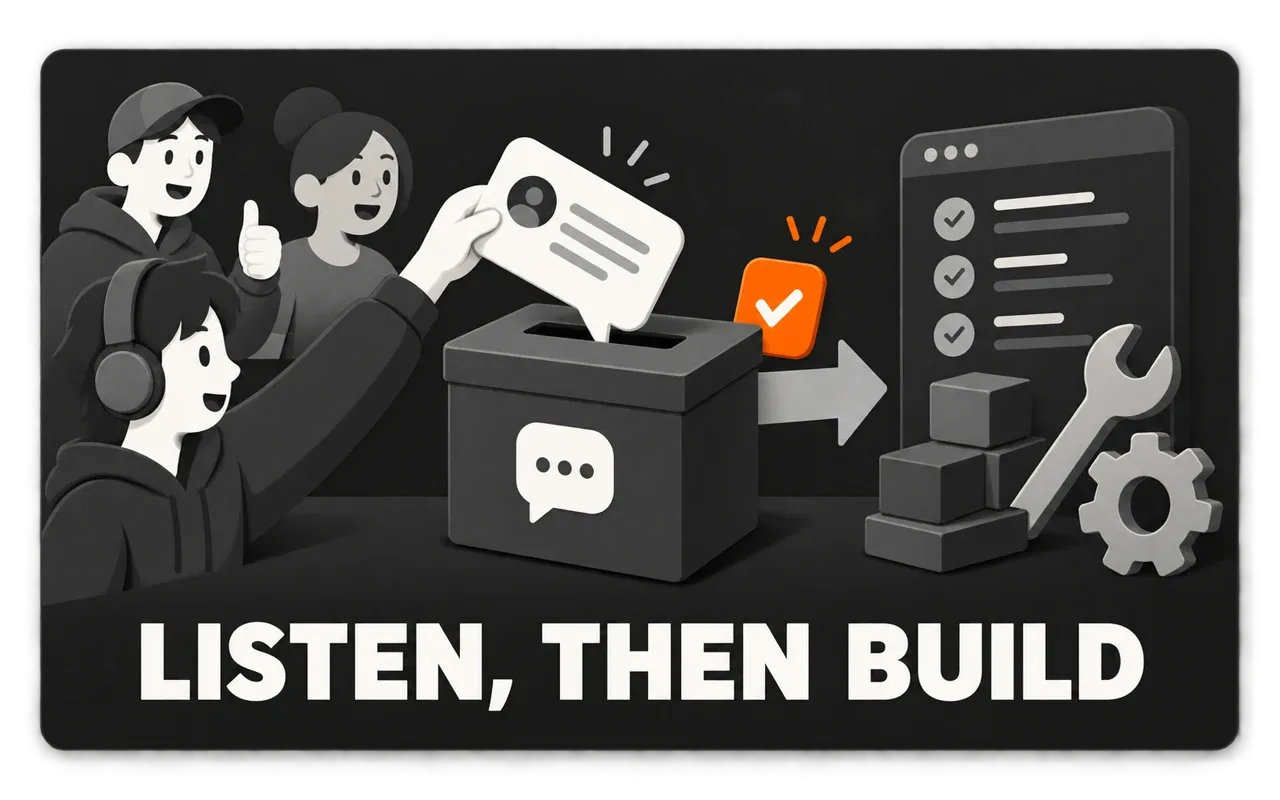
Most FiveM servers do not die from bad code. They die because the owner spent three months building something nobody asked for while the thing players actually wanted sat untouched. A real fivem player feedback system removes the guessing. Instead of betting your roadmap on a hunch, you collect what your community is telling you, separate signal from noise, and ship changes you can defend. This guide covers how to gather feedback, read it honestly, and close the loop so players keep talking to you.
Why feedback beats guessing
You are not your average player. You know every script and keybind, which makes you the worst judge of what a new arrival experiences. Owners who build on assumption chase their own pet features, polish systems five people use, and ignore the friction that quietly pushes newcomers out in the first ten minutes. Feedback is the cheapest course correction you will ever get. A single survey question can save you a month of work on a job nobody wanted, and a five-word Discord complaint can reveal a spawn bug you never hit because you always spawn at the same garage.
Channels for collecting it
Different players talk in different places, so do not rely on one funnel. Build a few low-effort entry points and let people use whichever fits.
- Discord suggestion channel with up and down reactions. Lightweight, public, and self-sorting. The community votes with emojis, and you get an instant rough ranking of what resonates.
- A structured suggestion board or forum for the longer ideas. Threads let people explain context, attach screenshots, and debate trade-offs without burying your chat. Categorize by jobs, vehicles, economy, and quality of life.
- Periodic surveys for the silent players who never post. A short form after a major update reaches people who will never open a forum thread.
- In-game commands like
/suggestand/reportthat capture feedback at the exact moment of frustration or inspiration, while the player is still in the world and remembers the detail.
- Exit feedback when someone leaves or goes quiet. A one-question “what made you stop playing?” prompt surfaces the reasons your active players never mention because they already adapted.
How to ask good questions
The quality of your feedback is capped by your questions. “What should we add?” produces a wishlist of impossible features and contradictory demands. Ask narrow, answerable questions instead.
- Rate a recent change on a simple scale. “How did the new gang territory update land for you, 1 to 5?” gives you a number you can track over time.
- Ask what frustrates them most right now. Frustration is specific and actionable; it points straight at the thing costing you retention.
- Ask about behavior, not fantasy. “Which job did you play last week?” beats “Which job is your favorite?” because it reflects what people actually do.
- Leave one open box for anything else, but lead with structured questions so you get comparable data, not just essays.
Keep surveys under two minutes. Every extra question drops completion and biases your sample toward the obsessive few.
Separating signal from noise
This is where most owners go wrong. The loudest voices in your Discord are a vocal minority who happen to enjoy posting. Meanwhile the silent majority, the people who log in, play, and log off without a word, are the ones whose retention pays your server bills. Treat stated wants as one input, not the verdict.
- Weight by playtime. A suggestion from someone with 300 hours carries more weight than a five-minute visitor demanding a total economy rewrite. Tie feedback to player data where you can.
- Watch behavior alongside words. If everyone swears they want hardcore roleplay but the racing zone is packed nightly, believe the metrics. People describe the player they wish they were.
- Look for patterns, not single posts. One angry message is an opinion. Twenty independent reports of the same friction is a problem you have to fix.
- Discount the contradictions. When half want stricter rules and half want more freedom, the answer is rarely the average. Find the specific pain underneath each side.
Closing the loop publicly
Collecting feedback and then going silent is worse than not asking, because it teaches players their input vanishes into a void. The biggest driver of more and better feedback is visibly acting on it.
- Keep a public roadmap and changelog. Show what is planned, what is in progress, and what shipped. People who can see the pipeline stop spamming the same request.
- Run a “you asked, we did” post after each update, explicitly linking changes back to the suggestions that prompted them.
- Credit the suggester by name. A small tag like “thanks to @player for the idea” turns one contributor into ten, because everyone now sees that posting gets noticed.
When players watch their words turn into features, your suggestion channel stops being a complaint dump and becomes a genuine pipeline of ideas.
Avoiding the pitfalls
Listening well is not the same as obeying. A few traps sink owners who take feedback too literally.
- Design by committee. If you build whatever the thread upvotes, you end up with an incoherent server stitched from a hundred conflicting visions. You still hold the wheel; feedback informs the direction, it does not replace your judgment.
- Promising everything. Saying yes to every idea guarantees you break most of those promises and torch your credibility. Say “not now” honestly and explain why.
- Knee-jerk reverts. Do not roll back a change the moment ten people complain. New things always draw friction; give players a week to adjust before judging a feature dead.
- Letting channels turn toxic. An unmoderated suggestion board becomes a pile-on where good ideas get buried under sniping. Enforce basic civility or thoughtful players stop showing up.
Turning feedback into a prioritized roadmap
End every cycle by converting raw feedback into an ordered plan. Group similar requests into themes, then score each on impact versus effort. High-impact, low-effort fixes go first; they buy goodwill fast and prove you are listening. Park the big, expensive ideas openly on the roadmap so people know they are on the radar without expecting them next week. Revisit the list every update, because what mattered last month shifts as your population grows.
- Collect across all channels into one place.
- Cluster into themes and weight by playtime and behavior.
- Score impact against effort and pick the top few.
- Ship, then close the loop publicly and credit the source.
For more retention and FiveM server-growth guides across the fleet, see cfxre-tebex.io, official-tebex.io, and marketplace-tebex.io.