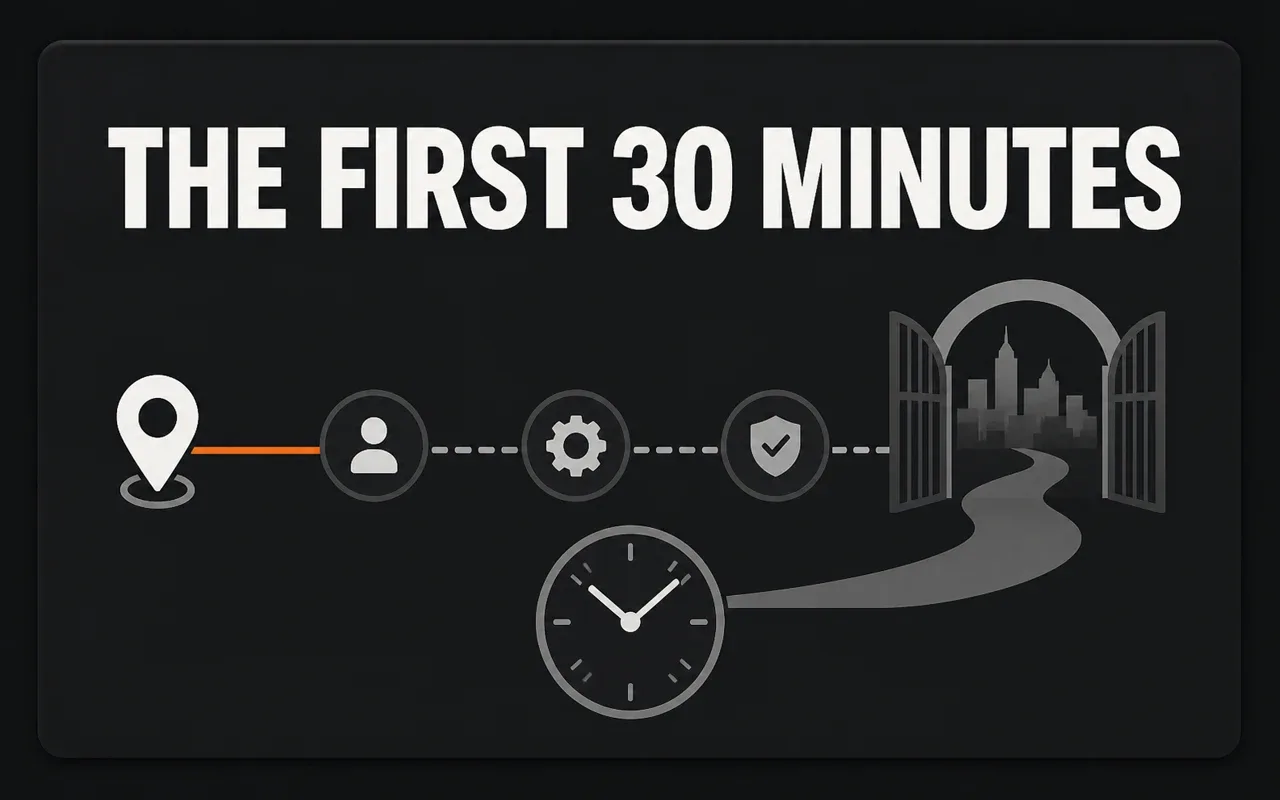
Most FiveM servers lose new players in the first half hour — not because the content is thin, but because the path to the content is invisible. A player who joins, spawns somewhere random, can’t find the job board, doesn’t know how to open their inventory, and can’t tell which Discord channel to ask for help in, leaves. They don’t file a support ticket. They just leave. Getting onboarding right is the highest-leverage improvement most servers can make, and most servers treat it as an afterthought.
The Spawn Decision: Where a New Player Lands Matters
The spawn point is the first piece of information a new character receives about the world. A beach spawn communicates “this is a survival server.” A hospital spawn with a registration desk NPC communicates “someone built this city with intention.” Most servers default to a random residential spawn that communicates nothing — the player could be in a neighborhood with no nearby services, no other players visible, and no obvious next step.
A dedicated new-player spawn zone with a short guided path to the nearest job board, clothing shop, and bank is worth the 2 hours it takes to design. It doesn’t have to be cinematic. It just has to answer the question every new player has within 30 seconds of spawning: what do I do first?
Character Creation: Keep It Functional, Not a Barrier
Character creation on QBCore is typically handled by qb-multicharacter or a replacement like Quasar Multicharacter. The default character creator drops players into a menu with dozens of sliders they don’t understand before they’ve seen anything of the server. Modern approaches front-load only the essential choices — name, date of birth, backstory fields if your server uses them — and defer clothing and appearance customization to an in-world barbershop or clothing store. This gets players into the city faster and naturally introduces those service businesses as something to visit.
The multicharacter lobby (where players choose between saved characters) should display the character’s last known location, money balance, and job if populated. Players returning from a break need that context to pick up where they left off without opening a support ticket asking “how do I continue.”
The Tutorial Problem: Players Skip What They Can Skip
Tutorial systems only work if they’re mandatory or if the cost of skipping them is visible. Optional tutorials get skipped by 80% of new players — the same 80% who will ask basic questions in support chat an hour later. If your server has a tutorial resource like a guidebook or quest chain, gate the starting cash or starting gear behind completing at least the first 3 steps. Players who receive something for doing the tutorial are more likely to finish it than players who are told they should do it.
The tutorial content itself should focus on mechanics unique to your server, not on explaining what FiveM is. Assume the player has connected to a FiveM server before. Explain the specific keybinds you’ve changed, the custom job-clock system, how your server’s legal versus illegal economy is structured, where the hospital is. Generic “press F to open inventory” tutorials insult players who’ve played FiveM for years and teach nothing to players who are genuinely new to your specific setup.
First Job: Design for Low Stakes and Immediate Feedback
The first job a new player takes should have four properties: easy to find, low failure risk, immediate cash payout, and at least one NPC interaction that makes the city feel inhabited. Delivery jobs and taxi jobs satisfy all four. Mining and drug running fail at “low failure risk” — new players who die losing their ore or get busted on a drug run in the first 30 minutes don’t come back.
In QBCore, a starter job accessible without a whitelist application — something like a logistics delivery or garbage collection route — lets a new player earn their first $200–$500 without asking anyone for help. That first self-sufficient earning is disproportionately important to retention. It proves the server’s economy is real and accessible. Make it possible to earn starting money alone before asking the player to find a faction or talk to an admin.
Inventory and Phone: The Two Systems New Players Hit Immediately
Inventory opens on a key (typically F2 or the equivalent from your setup). Phone opens on a key or a built-in animation. If either of these fails on first use — wrong key shown in the tutorial, phone resource not started, inventory NUI not loading — the player’s first interaction with your server’s core systems is a broken one. This sounds obvious, but inventory key conflicts with other resources are extremely common on servers assembled from multiple script packs.
Check new player flows after every major script update. Sit in a fresh character slot, work through the first 30 minutes, and note every point of friction. This takes 30 minutes and catches problems that your experienced admin team, who know all the keybinds and shortcuts by muscle memory, will never notice.
Communicating Server Rules Without a 4,000-Word Document
Most servers have a rules document no new player reads in full. Surface rules contextually instead: display the “no random deathmatch” rule when a player first equips a weapon; show the “no meta-gaming” rule when the phone opens for the first time. Rules attached to the action they govern are absorbed far better than a wall of text at login.
For onboarding systems with contextual prompts and graduated tutorial flows, scripts-tebex.io has relevant resources. If you’re building a QBCore server from scratch and want the character creation and starter job pipeline already integrated, qb-tebex.io covers the framework-level setup. For resources built with player experience as a design constraint rather than an afterthought, buy-tebex.io is a good reference point.